

The Multiplier Effect
Can Your Multiplier be Used to Decide Compensation?
If you are in a technical professional services business (Architecture, Engineering, Consulting – AEC) you are probably familiar with the hourly billable rate setting rule of thumb for your employees called “the Multiplier”.
Using a Multiplier factor of 3X to 3.5X on an employee’s basic hourly pay to establish their bill out rate should be a way to feel confident that you can pay people fairly and have your resulting net income ensure long term viability of the business.
In isolation, viewing margin on a single project, this may look to be true.
There are more complexities and implications to the Multiplier rule of thumb that can be difficult to see and I’d like to cover the key ones here today. For the purposes of this example, we are going to ignore payroll taxes and benefits.
Here are the assumptions:
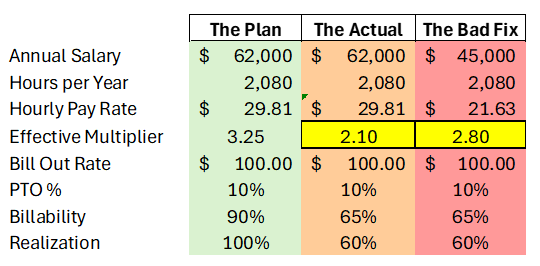
Table 1.
PTO is Paid Time Off. Billability is the % of available hours spent on billable client work. Realization is the percentage of time spent on client work that actually gets invoiced to the client.
Multiplier, Billability and Realization
A concept that is valuable to examine is what we call the “Effective Multiplier”. Achieving the expected financial result from using the Multiplier requires that the employee is appropriately billable throughout the year and that the firm’s project management and client experience processes ensure that hours worked on client projects end up being billed to the client. These underlying assumptions are in Table 1. “The Plan”.
In our consulting business, we typically encounter businesses that are off plan, despite the owner feeling confident that their posted rates conform to the common Multiplier wisdom. Unfortunately, the underpinnings of that wisdom are not working in their businesses. Their employees are under-billable and their realization is poor. The billability and realization assumptions are in “the Actual” column in Table 1.
That does not produce a sustainable business.
In the absence of data that shows the root cause, it can be tempting to deal with the obvious issue, “this role is not generating margin at the rate I am paying”.
To mitigate the disappointing and problematic financial results, the owner then leaves the posted billable rate at market and looks to hire employees at 20%-30% less than the Multiplier math suggests, in order to claw their way back to close to the results that will allow them to stay in business. This is shown in the “Bad Fix” column in Table 1.
Here are summary financial results for each of the scenarios that assume the lower paid employee could actually produce the same amount of work as the higher paid employee:
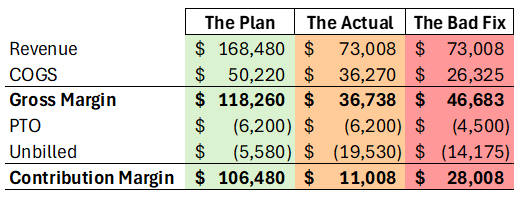
Table 2.
Contribution margin is the all-in direct financial contribution that a production employee makes to your business. The Actual contribution margin is 10% of the Multiplier model. The Bad Fix probably gets the firm to bottom line break even, but no better.
The Bad Fix financial results show up in industry benchmarking as the lowest quartile, or even lowest decile.
What the owners of those firms experience, and that we hear all the time are comments like: “I can’t find good people; I keep losing people to the competition; no one wants to work any more; I can’t afford raises for my people”.
It’s because you are underpaying to market. And, there is no raise you can give that will fix this situation, because the pay increases will come out of your profit. You don’t have any? Then it’s coming out of your personal line of credit or you are plugging the holes with your own sweat equity.