Overcompensating: When Pay Disconnects from Value Creation
In an ideal world, an owner gives an employee a raise because they have seen that person grow, take on greater responsibility, develop valuable skills, and contribute at a higher level.
And sometimes an owner gives a raise for completely different reasons, perhaps because they are afraid the employee might leave.
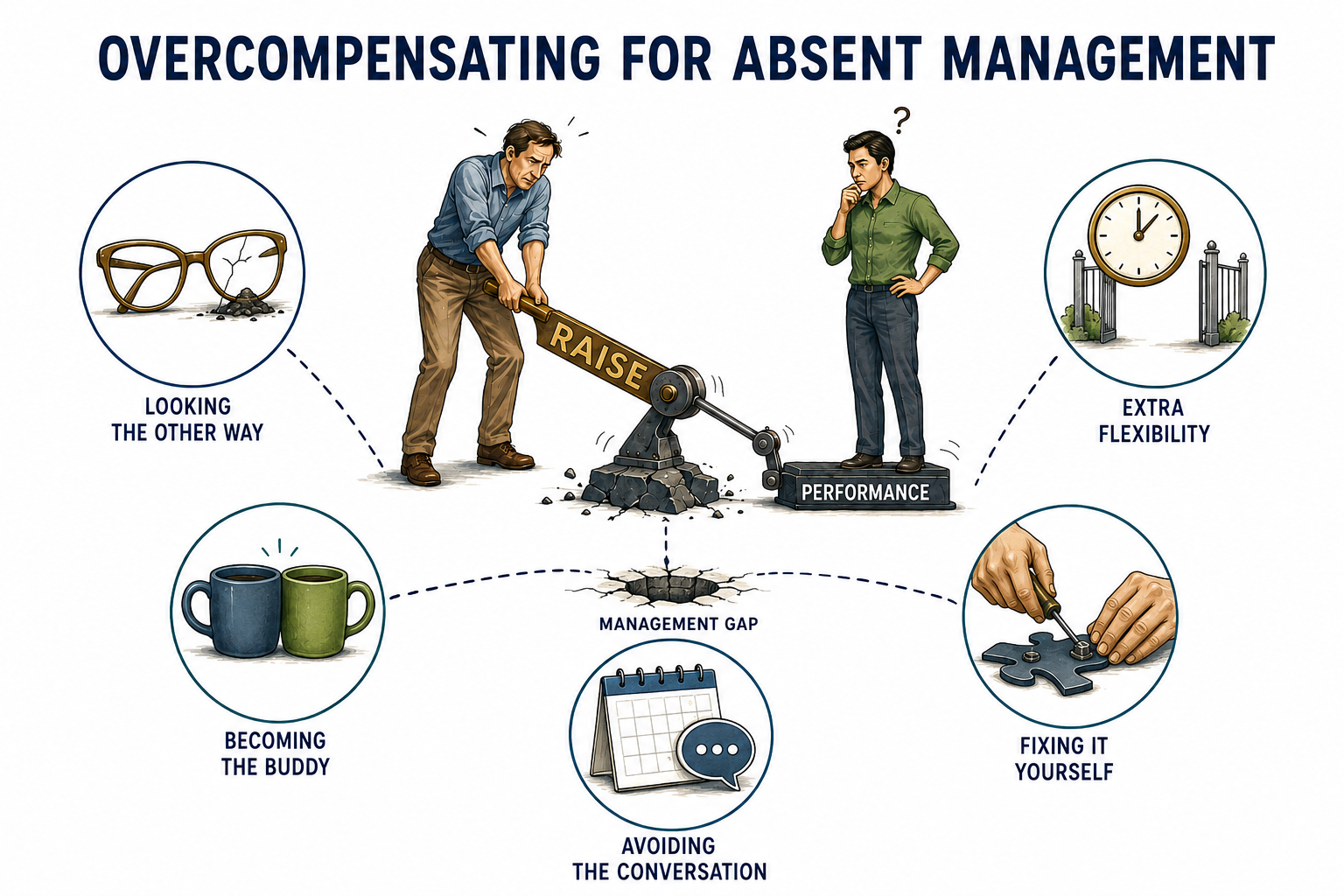
That second situation is often part of a larger pattern I call overcompensating. It is a little tongue-in-cheek because this behaviour that we see is not only about paying too much, it can also be about permitting behaviours that have hidden costs that erode efficiency, engagement, and productivity and still hit the bottom line even when no raise has been given. The overcompensation can result from a number of beliefs the owner has. The most common are “my employees are doing me a favour working for me”; “a leader must be liked in order to lead”; “I’m uncomfortable with conflict”; “I shouldn’t need to tell employees what to do”.
I would even argue that the overcompensation can be more costly than the real solution – investment in management and true compensation that the employee would appreciate more.
What You Permit, You Promote
We worked with a client a while back, let’s call him Bob. Bob had grown his business over time and had a range of employees most of whom were strong and committed. There were challenges though: one of those was Joe. Joe had been around a long time and was a very able Crew Chief with a lot of experience but a chip on his shoulder. He showed up late, worked hard only when he was in the mood, didn’t take instruction on priorities, and would leave without warning if he felt that there was nothing that needed doing. He took no responsibility for equipment or vehicle condition and felt like field notes were “over-rated”.
Bob had tried talking to Joe but was met with threats and demands, and even veiled accusations from Joe that blamed Bob and implied that he just didn’t understand running a business.
Bob was frustrated and felt like he was held hostage by his most experienced team member. He was afraid about what would happen if Joe quit. This had put Bob in a place of inaction, stress, and a growing worry about the impact on the rest of the team.
Management Missing
Where I usually see this pattern crop up is when a leader tries to compensate for absent management.
The owner or leader knows expectations have not been clear. Tardiness has been tolerated. Work that does not quite meet the standard has been accepted because there is no time to re-train the employee. Feedback (even positive feedback) has been delayed because there was never a good time—or because the owner was not confident about how to deliver it.
Instead, the owner tries to keep people happy. They overlook things, give afternoons off, avoid difficult conversations, become the employee’s buddy, or agree to a raise in hopes that better performance will follow.
Underneath these choices is often a quiet awareness:
“I haven’t properly trained, equipped, coached, or managed this person. How can I hold them accountable now?”
That is a legitimate concern. But avoiding accountability does not correct the management gap. It compounds it.
The costs go far beyond compensation
When leaders allow expectations to remain optional, employees receive incomplete or contradictory information about what good performance looks like. Capable employees may remain underdeveloped. Poor performance becomes normalized. Problems are addressed only when the owner is sufficiently frustrated, creating conversations that feel reactive and personal.
Strong performers notice too.
They see colleagues receiving the same flexibility, recognition, or compensation without creating the same value. Over time, discretionary effort begins to feel foolish. The business risks losing the people it most wants to retain while working increasingly hard to accommodate those who contribute less.
The financial costs accumulate too: rework, missed deadlines, additional supervision, seniors fixing the work of those more avoidable write-offs, customer dissatisfaction, lower capacity, and wages that grow faster than value creation.
A raise cannot repair these problems. In fact, it can make the eventual performance conversation harder. The employee reasonably interprets increased pay as evidence that their performance is meeting (or exceeding) the standard.
This is both a leadership challenge and a business-stage challenge
Overcompensating can come from inexperience, lack of confidence, or an understandable desire to be liked. But it can also reveal a structural gap in the business.
There may be no management framework and skill development. Roles and standards may be unclear. Managers may not have protected time for delegation, training, feedback, development, and accountability. The company may have no compensation design connecting pay to market rates, skills, responsibility, contribution, and progression.
This is especially common in a business at what we designate as VS0—the survival stage. The owner does not yet have enough time or profit to work on the business because they are consumed by working in it. Management happens between client emergencies. Compensation decisions happen when someone asks for a raise. Performance conversations happen when something has already gone badly wrong.
The way out is not to become colder or less generous. It is to become more willing to lead.
A skilled manager creates clarity about roles and expectations. They teach, delegate, observe, coach in the moment, recognize good work, and address gaps while they are still small. They know what the employee can do today and what development would prepare them for tomorrow.
A well-managed team consumes less time than not managing them once the framework and skillset is established.
A well-designed compensation framework then makes pay conversations more logical. Cost-of-living adjustments, market corrections, increased skills, additional responsibilities, promotions, and demonstrated value creation can be considered separately rather than bundled into one emotionally charged decision.
People deserve fair compensation. They also deserve good management.
When both are present, a raise no longer has to carry the weight of guilt, fear, hope, or avoidance. It can mean what it should mean: a fair and sustainable recognition of the value an employee is equipped—and accountable—to create.