
Why Growing Firms Feel Busy but are Not Necessarily Productive
Translating Big-Business Research into Lessons for Smaller Professional Services Firms
One of the most common conversations we have with leaders of growing professional services firms goes something like this:
“We’re busier than ever, but profitability doesn’t seem to reflect the effort the team is putting in.”
Projects are moving. The team is working hard. Revenue may even be climbing.
Yet the business feels harder to run than it did two or three years ago. Decisions feel reactive. Leaders spend more time firefighting than thinking strategically.
What’s interesting is that this problem isn’t unique to smaller firms. Research from organizations like McKinsey, Deloitte, and Harvard Business Review points to the same productivity challenges inside large enterprises.
The difference is that large organizations often have systems and management infrastructure to eventually solve these problems. Smaller firms typically do not—at least not yet.
And that gap is where leadership growth becomes essential.
The Productivity Gap Is Real
McKinsey research on operational excellence suggests that organizations that implement disciplined management systems can improve productivity by 25 percent or more. At the same time, Deloitte research indicates that employees may spend as much as one-third of their time on “performative work”—activity that looks productive but creates little real value.
Harvard Business Review has also highlighted a similar dynamic in knowledge-based work. Because outputs are less tangible than in manufacturing, productivity becomes difficult to measure unless organizations deliberately create systems that make work visible.
These studies are usually framed around large organizations. But the underlying lesson applies just as strongly to smaller firms.
Productivity problems are rarely caused by people working too little.
They are almost always caused by work that cannot be clearly seen, coordinated, or measured.
Why Smaller Firms Hit the Same Wall
In the early stages of a firm, informality is an advantage.
When a team is small:
- Work can be coordinated through conversations
- Leaders have direct visibility into most projects
- Decisions happen quickly
A firm can run effectively this way with five or six people.
But somewhere between 10 and 20 team members, the organization reaches a tipping point. Complexity grows faster than the operating structure supporting it. We call this the Doldrums… your ship is still full of treasure but you feel like the wind has left your sails.
Projects overlap. Team members share responsibilities across multiple initiatives. Information lives in different places—emails, spreadsheets, conversations.
At this stage, the business is no longer simple enough to run informally, yet it has not developed the management discipline of a larger firm. This is when leaders start to experience what many describe as the growth paradox:
The company is successful, but it feels increasingly difficult to manage.
The Leadership Identity Shift
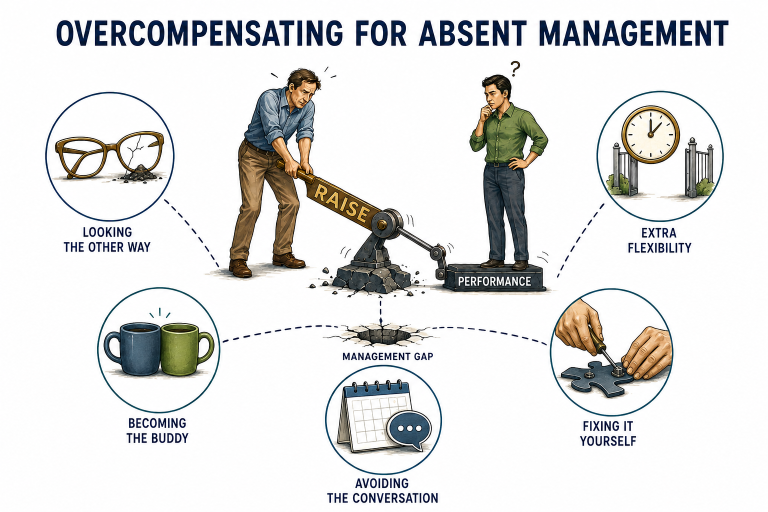
What often goes unspoken in productivity research is that operational challenges are deeply connected to leadership identity.
Many founders build their firms through technical excellence and personal drive. In the early years, success comes from being the person who solves problems, makes decisions quickly, and keeps clients happy.
But as the organization grows, the role of the leader must evolve. Instead of solving every problem personally, leaders must begin to design systems that allow the organization to solve problems consistently.
This shift—from doer to designer of systems—is one of the most important leadership transitions a business owner will make.
It can also be one of the most uncomfortable. For many leaders, stepping back from operational heroics can feel like losing control. In reality, it is the opposite. Creating structure is how leaders regain visibility and leverage.
From Heroic Effort to Operational Clarity
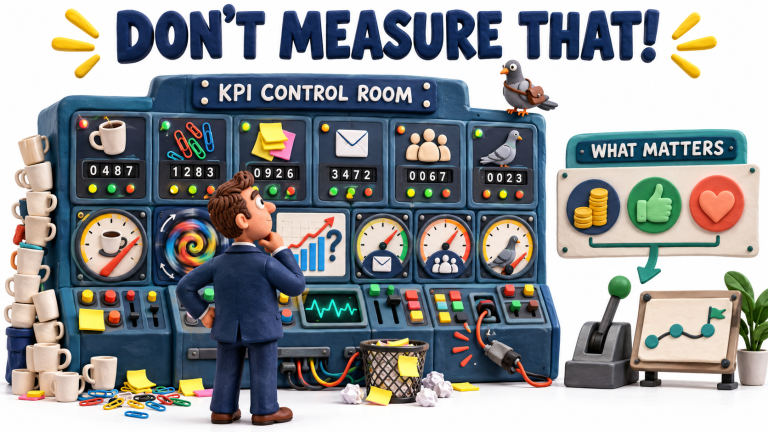
Research on productivity consistently points to a simple principle: high-performing organizations make work visible.
They build management practices that allow leaders to see how effort translates into results.
In professional services firms, this often involves introducing disciplines that may not have been necessary in earlier stages of growth:
- consistent time and project tracking
- clearly defined roles and responsibilities
- standardized workflows and communication practices
- operational dashboards that show utilization, backlog, and margins
These practices are not about bureaucracy. They are about clarity.
Without them, organizations rely on heroic effort and constant problem-solving. With them, leaders gain the ability to see patterns, anticipate problems, and make informed decisions about growth.
Technology increasingly supports this transition. Operational platforms designed for professional services can connect project management, resource planning, and financial insight in ways that spreadsheets cannot.
But technology alone does not solve the problem.
Leadership intention does.
Productivity Is Ultimately a Leadership Discipline
The most productive firms are rarely the ones with the most talented people or the best tools. They are the firms where leaders have made a deliberate decision to run the business with clarity.
They measure what matters.
They define responsibilities and build accountability.
They create systems that allow the organization to operate predictably.
And perhaps most importantly, they recognize that building a firm is not only about delivering great work for clients. It is about designing an organization that can sustain that work without exhausting the people who do it.
Scaling Down Big-Business Insight
At Tradewinds, we often say that our role is to scale down big-business insight for smaller firms.
Research from McKinsey, Deloitte, and Harvard Business Review consistently highlights the importance of operational clarity and productivity systems in large organizations.
The lesson for smaller firms is not that they need to copy the complexity of large enterprises. It is that they must eventually adopt the disciplines that make growth sustainable.
Because the real goal of building a business is not simply to stay busy. It is to create an organization that works with clarity, confidence, and purpose—one that supports both its clients and the people who lead it.