Management Frameworks
Helping Managers and Teams Do Their Best Work
“I have good people. Why do I still have to chase things, answer so many questions, and step in to get work finished?”
I hear versions of this regularly from business leaders. They have hired capable people and care about their team but something seems to be missing when it comes to helping those team members get the expected results.
They know they want new results, but managing feels like an ongoing series of interruptions, reminders, and uncomfortable conversations… and team members feel the same way. I call this “Drive-by Feedback”.
Without a Management Framework and shared language and expectations, this spontaneous input can make a team member feel singled out, embarrassed or ashamed, and insecure. This only leads to more hesitancy on both the team member’s and the manager’s part.
Managers and supervisors feel that uncertainty. They (you) are responsible for results, but may have little guidance on how to set expectations, delegate effectively, address performance, or develop their people.
A management framework gives your business a shared way of managing work and people. Much ore than an Organization Chart, it brings together the principles, roles, practices, and processes that help everyone understand how the business operates—and what is expected of them.
It helps owners, managers, and team members answer practical questions:
- How do we make decisions, and who has the authority to make them?
- Who is responsible for each part of the workflow?
- How do we coordinate priorities, handoffs, and commitments?
- What information do people need to do their work and make good decisions?
- How do we review progress, recognize contributions, and address performance?
- How do we discover an employee’s strengths, aptitudes, and attitudes? And how do we develop individual employees at different stages in their growth?
- How do we help team members learn from experience and improve?
Having those answers creates clarity. Putting them into practice consistently gives managers and teams a dependable way to work together.
It gives both managers and employees a clear, consistent way to work together. It defines how expectations are established, work is delegated, support is provided, performance is discussed, and commitments are followed through.
For managers, it also answers equally important questions: What is expected of me as a manager? What KPIs (Key Performance Indicators) are tied to the work I do in management (How do I know I am doing a good job as a manager)? What conversations should I be having? How do I handle a missed commitment? When do I coach, clarify, or intervene?
We often promote someone (or add management or supervisory responsibilities) because they are excellent at their work, then expect them to know how to manage other people doing it. That is a significant new responsibility. They need a language, processes, and time to do it well.
A framework can also describe how to make management part of the expected rhythm of their work: regular check-ins, clear delegation, timely feedback, recognition, development reviews. Managers gain confidence because they have a way to approach situations and know they are expected to address them.
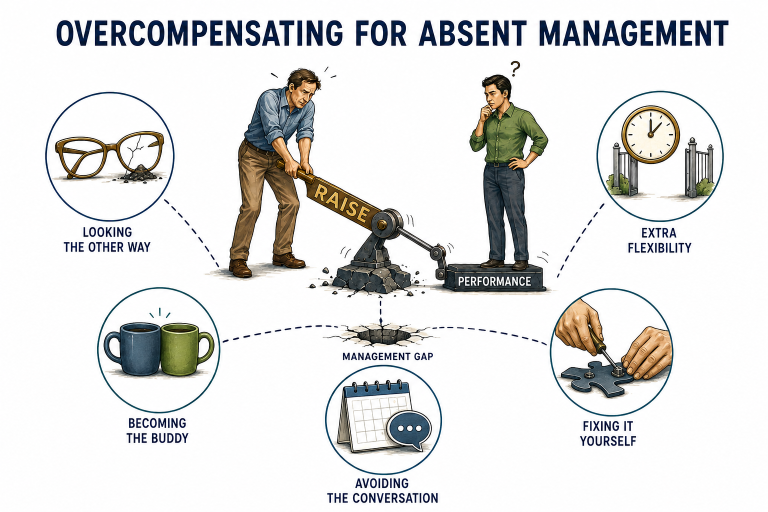
Consider an employee who repeatedly misses deadlines. Without a framework, a manager might avoid the conversation, express frustration, or quietly take the work back.
A developmental management approach (that we and many others espouse) gives them a positive process: establish what happened, explore the contributing factors, clarify the standard, agree on action, and follow up. Recognize progress.
Where was there a process problem? Was the deadline unclear? Were competing priorities resolved? Did the employee have the skills and resources? When should they have raised the concern? Do we have a safe space to raise that kind of concern?
The commitment still matters. So does understanding what will help the person meet it next time.
Positive management requires stretch, support, and accountability. Employees deserve honest feedback and a fair opportunity to succeed and grow. Managers need the training, tools, and authority to provide those.
The Developmental Management Framework provides a shared language for understanding how people contribute and how their talents can support the outcomes of their role. It connects strengths, role clarity, purposeful delegation, regular communication, and development through everyday work.
That shared approach creates consistency across the firm. Employees know what to expect, and managers can learn from one another.
We have found that building that shared language together through firm-wide assessments and training on strengths and development can reduce (or even reverse!) the discomfort of crucial conversations.
One of our clients with whom we “installed” the Developmental Management Framework told me that after the Strength Assessments and all-hands workshop day he still put off the first one-to-one coaching session with one of his “challenging” employees. When he at last booked that person in (last on the list), the team member showed up excited and eager for his coaching – enthusiastically thanking the boss for getting it scheduled, and participating in the session positively.
(it’s true! I am not embellishing this story at all.) Positive accountability creates respect and helps individuals understand the value they bring to a job well done.
Developing people takes scheduled time, learning, and practice. A clear framework that reduces the emotions and provides strong insights into how to manage and be managed makes this an easier lift for the whole firm.
And when management has a shared framework and language, a clear rhythm in the working week, and straightforward measures of success, that investment becomes something the business can depend on.